Donghai County, Jiangsu, China · Custom Quartz Glass Manufacturer & Exporter English
Avg. Response≤ 2 Hours
Contact Us
0%

Fused Quartz Glass is valued for its high thermal stability, low thermal expansion, and optical performance. Buyers use it in demanding settings, from semiconductor equipment to laboratory assemblies. But “high purity” alone does not guarantee a suitable part. Grade, hydroxyl content, bubbles, inclusions, surface finish, and dimensional tolerances can all affect performance. Small differences matter.

Demand trends offer useful context, not a purchasing specification. IRENA’s Renewable Capacity Statistics 2024 reports that global solar capacity reached 1,419 GW by the end of 2023, with 346 GW added that year. This growth highlights expanding industrial supply chains, but IRENA does not measure fused-quartz demand directly. That distinction matters. A buyer should rely on application requirements and supplier documentation, not broad market headlines.

Before requesting a quote, define the operating temperature, exposure conditions, required geometry, and acceptable inspection limits. Ask for a material certificate, batch traceability, and test methods for critical properties. Compare suppliers on consistency, machining capability, packaging, and lead time—not price alone. For example, a tube that looks clear under warehouse lighting may still contain defects that matter in a high-temperature process. Even a careful checklist has limits; specifications should be reviewed against real operating conditions. The following seven tips provide a practical starting point for evaluating suppliers and choosing Fused Quartz Glass with fewer costly surprises.
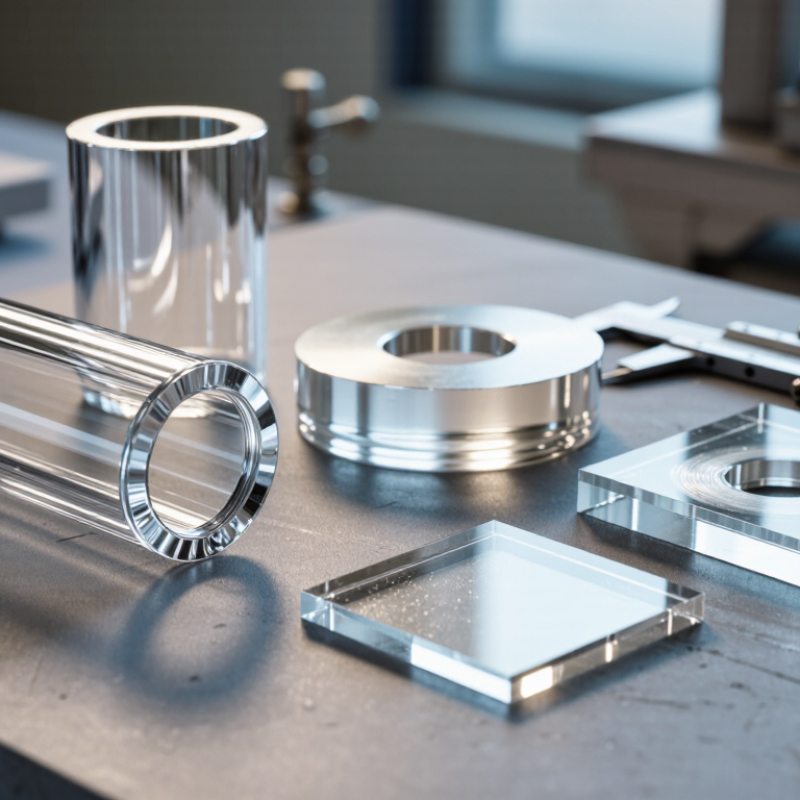
7 Tips for Buying Fused Quartz Glass

Define UV–IR Needs: Grade-Dependent Transmission Can Span ~185–3,500 nm

When defining UV–IR needs, treat 185–3,500 nm as a possible working span, not a guarantee for every fused-quartz part. Grade, hydroxyl content, thickness, and surface finish all affect measured transmission. A 1 mm UV-grade window may perform differently from a thicker, higher-OH tube. Check the curve for the actual grade and thickness—not just a catalog’s headline range.

The technical review by Kitamura, Pilon, and Jonasz in Applied Optics (2007, 46(33), 8118–8133) describes silica glass’s wavelength-dependent absorption, including UV and infrared features. Those features matter in practice: OH-related absorption can reduce transmission in parts of the near-infrared, while UV performance depends on material purity and processing. Small details count. Ask for spectral-transmission data at your operating wavelengths, plus the test thickness and measurement conditions.

Specify the source wavelength, detector band, incidence angle, and acceptable transmission before comparing quotes. If your system spans 200 nm to 3.2 μm, request data at both endpoints and across the band; a few catalog values may hide a dip. It is tempting to choose the broadest stated range. That can be the wrong shortcut: confirm the part in your optical path, then verify it with a spectrophotometer when performance is critical.

Compare OH Content: Low-OH Grades May Be Specified Below 10 ppm

7 Tips for Buying Fused Quartz Glass

A low-OH grade may be specified below 10 ppm, but treat that figure as a purchase requirement, not a universal cutoff. Hydroxyl groups absorb infrared light and can affect how fused silica performs in heat-sensitive applications. Dodd and Fraser’s 1966 Journal of Applied Physics study describes measuring OH through absorption near 2.73 μm. Ask for the measured value and the test method.

Check the certificate carefully. Does “below 10 ppm” mean a measured result, or only a maximum limit? Ask whether the result applies to the delivered lot and how the supplier reports measurement uncertainty. Small details matter. A single number without its method is hard to compare across suppliers.

Match the grade to the job. For infrared optics, OH-related absorption may be important; for other uses, thermal behavior or UV transmission may matter more. Request a representative test report, and confirm that the sample reflects the finished material, not merely a process target. This can feel overly cautious. It is still worth doing. A specification below 10 ppm should support a clear application need, rather than serve as a quality label on its own.

7 Tips for Buying Fused Quartz Glass - Compare OH Content: Low-OH Grades May Be Specified Below 10 ppm

Tip What to Compare Example Purchasing Check Why It Matters
1. Compare OH content Hydroxyl (OH) concentration, reported in ppm, and the measurement method. For a low-OH application, request a documented maximum below 10 ppm. Confirm whether the value is a guaranteed limit or a typical value. OH content can affect infrared transmission and thermal behavior. Results depend on material and measurement method, so compare like-for-like certificates.
2. Match the material type to the application Natural fused quartz and synthetic fused silica may differ in OH level, trace impurities, and optical characteristics. Specify the required material origin or manufacturing route when it affects the end use; do not select by the word “quartz” alone. Material routes can produce different properties. Confirm the actual grade against the wavelength, purity, and process requirements.
3. Check optical transmission at your wavelength Transmission range, sample thickness, surface finish, and test conditions. Ask for a transmission curve or a measured value at the operating wavelength and representative thickness. Transmission varies with wavelength, thickness, surface condition, and material grade; a single unspecified percentage is difficult to compare.
4. Define bubbles and inclusions Permitted bubble size, number, and inspection area, plus limits for visible inclusions. State acceptance criteria by size and count per defined area or volume, and agree on the inspection method. Clear inspection rules reduce ambiguity, particularly for optical parts and components used under vacuum or at elevated temperatures.
5. Verify dimensions and tolerances Thickness, diameter or length, flatness, parallelism, and dimensional tolerance. Provide a drawing with units and tolerances; confirm whether measurements apply before or after finishing. Tolerance requirements can affect yield, machining, lead time, and cost. Standard stock dimensions may not meet finished-part needs.
6. Specify surface finish and edge condition Polished, ground, or fire-polished surfaces; roughness where relevant; chamfer or edge finish. Describe the required finish on each face and edge, and request a roughness value only when it is functionally important. Surface finish affects optical losses, sealing, cleanliness, and handling. “Polished” should be defined for critical work.
7. Request traceable quality documentation Certificate of analysis, lot identification, test results, and packaging or cleanliness requirements. Ask that the certificate identify the delivered lot and include the agreed OH limit and other critical acceptance criteria. Traceability helps verify that delivered material matches the purchase specification and supports consistent incoming inspection.

Note: Specifications and measurement methods vary by supplier and grade. Treat example limits as purchasing criteria to confirm in writing, not as universal properties of fused quartz glass.

Check Thermal Fit: CTE Is About 0.55 × 10⁻⁶ K⁻¹ at 20–300°C

When checking thermal fit, treat the coefficient of thermal expansion as a design input, not a sales detail. Industrial fused-quartz data sheets commonly list about 0.55 × 10⁻⁶ K⁻¹ over 20–300°C. The value is low, but not zero. Over a 100 mm part and a 280°C rise, expansion is roughly 0.015 mm. That can affect a close-fitting seal or rigid mount.

Compare that figure with the CTE of every contacting material, then consider the actual temperature gradient—not just the furnace set point. A metal holder may heat faster than the glass, creating stress before both reach the same temperature. Ask for a lot-specific test report and the temperature range used. ISO 7991 specifies a method for measuring glass expansion; ASTM E228 describes dilatometry for solid materials. These references help make supplier values more comparable, though test conditions still matter.

Check the assembly, too. A compliant gasket or a small clearance may accommodate mismatch; a rigid clamp may not. Review edge finish and wall thickness, since flaws and uneven heating can complicate thermal performance. The nominal CTE is useful, but it cannot predict every installation. That part needs testing.

Set Temperature Limits: Fused Silica Softens at About 1,660°C

Treat 1,660°C as a softening reference, not a safe continuous-use rating. Published fused-silica technical data sheets commonly place the softening point around 1,660–1,670°C. ASTM C338 and ISO 7884-6 describe standardized ways to measure glass softening, not a universal operating limit. At the softening point, silica is extremely viscous, not suddenly liquid. A loaded tube may sag or fail at a much lower temperature. Not a cliff.

For a practical comparison, ASTM C338 associates the softening point with a viscosity of about 10⁷·⁶ poise, or 10⁶·⁶ Pa·s. That benchmark helps explain why shape and support matter: a long, thin tube can deform sooner than a compact, thick-walled part. Check the supplier’s temperature-time guidance, and ask whether it applies under load and in your atmosphere. Don’t rely on the headline number alone.

Temperature cycling matters too. A hot furnace door, a cold airflow, or a small contact point can create steep gradients and stress the glass. One caveat: published values vary with purity and test method, so a few degrees of apparent precision can mislead. Before buying, match the part’s dimensions and duty cycle to its technical data, then leave a margin below the stated softening point.

Verify Dimensions, Tolerances, and Surface Finish Against Drawings in mm

Before approving a fused quartz glass order, compare the quotation with the latest drawing, not an old email attachment. Confirm every dimension in millimetres (mm), including overall length, wall thickness, hole positions, and edge features. Check the tolerance beside each critical dimension. A general tolerance may not cover it. Ask how measurements will be taken and whether an inspection report is included.

Surface finish needs equally clear wording. Specify whether faces should be polished, ground, or accepted to a stated roughness value, such as Ra. Agree on where and how it will be measured; readings can differ with the method and location. For visible edges, define acceptable chips, scratches, or marks before production. That matters. A drawing can look precise while leaving “smooth” open to interpretation. It is easy to miss a unit or revision during a rushed review, so mark confirmed dimensions and tolerances directly on the controlled drawing. If a feature is unclear, pause and resolve it in writing. I would not assume an unlisted detail is included.

FAQS

Can fused quartz transmit from 185 to 3,500 nm?

Sometimes, but that range is not guaranteed for every part. Grade, hydroxyl content, thickness, and surface finish affect transmission. Check data for the exact grade and thickness.

Why request transmission data across my operating band?

A broad stated range can hide a transmission dip. For a system spanning 200 nm to 3.2 μm, request measurements near both endpoints and across the band. Include test thickness and measurement conditions.

What does a low-OH specification below 10 ppm mean?

Treat it as a purchase requirement, not a universal cutoff. Ask whether it is a measured result or a maximum limit. Confirm it applies to the delivered lot.

How can hydroxyl content affect infrared performance?

Hydroxyl groups can absorb infrared light, including near 2.73 μm. Request the measured value and test method. A number alone is not enough.

What thermal expansion should I expect?

A typical value is about 0.55 × 10⁻⁶ K⁻¹ from 20°C to 300°C. It is low, not zero. For a 100 mm part heated by 280°C, expansion is roughly 0.015 mm.

Why compare the glass with its mount materials?

Different materials expand at different rates. A metal holder may heat faster than the glass, creating stress before temperatures equalize. Check the actual temperature gradient, too.

Can a rigid mount cause problems?

It can. A compliant gasket or small clearance may accommodate mismatch, while a rigid clamp may not. Check wall thickness and edge finish. Small flaws matter.

Is a supplier’s nominal value enough to approve a part?

Not always. Ask for lot-specific test data and verify critical performance in the actual assembly. I may be overchecking it, but a test fit can reveal surprises.

Conclusion

Choosing Fused Quartz Glass starts with matching its optical properties to the job. Define the required ultraviolet-to-infrared range, since transmission varies by grade and may span roughly 185 to 3,500 nm. If low absorption or specific spectral performance matters, compare hydroxyl content; some low-OH grades can be specified below 10 ppm. These details help ensure the material suits the intended optical or thermal application rather than relying on a generic description.

Next, check whether the material’s thermal behavior and working limits fit operating conditions. Its coefficient of thermal expansion is about 0.55 × 10⁻⁶ K⁻¹ over 20–300°C, while fused silica softens at around 1,660°C; these figures are reference points, not substitutes for application-specific limits. Finally, verify dimensions, tolerances, and surface finish against the engineering drawings, using millimeters consistently. Clear specifications make it easier to assess whether a selected grade and finished component meet the required performance.

Oliver

Oliver

Oliver is a professional marketing specialist who combines a deep understanding of the company’s products with a clear, practical approach to communication. Through his regular blog articles, he helps readers understand how the company’s solutions work, what needs they address, and how to choose......