Industrial equipment exposes materials to heat, chemical contact, rapid temperature changes, and demanding production schedules. Fused Quartz can suit these conditions because it combines high-purity silica with low thermal expansion. A quartz tube may move from a hot process zone toward cooler surroundings with less risk of thermal shock than many ordinary glasses. That can matter in semiconductor equipment, laboratory vessels, lamps, and optical systems. Small details count. Surface finish, wall thickness, purity, and fabrication quality all affect performance.
The material is not magic. Fused Quartz can devitrify under prolonged high-temperature exposure, and its resistance depends on the chemicals, temperature, and service duration involved. A good specification should match the actual operating environment, not rely on a broad claim of heat resistance. Engineers should also consider machining tolerances, cleaning methods, and replacement costs. A test component can reveal problems that a datasheet misses. That is sometimes inconvenient, but useful. No verifiable quotation from a named Fused Quartz specialist was provided, so I will not invent one or attribute words without a source. The practical question remains clear: does the material’s stability justify its cost in this particular process? When the answer is supported by operating data, Fused Quartz can be a dependable choice—not a universal one.
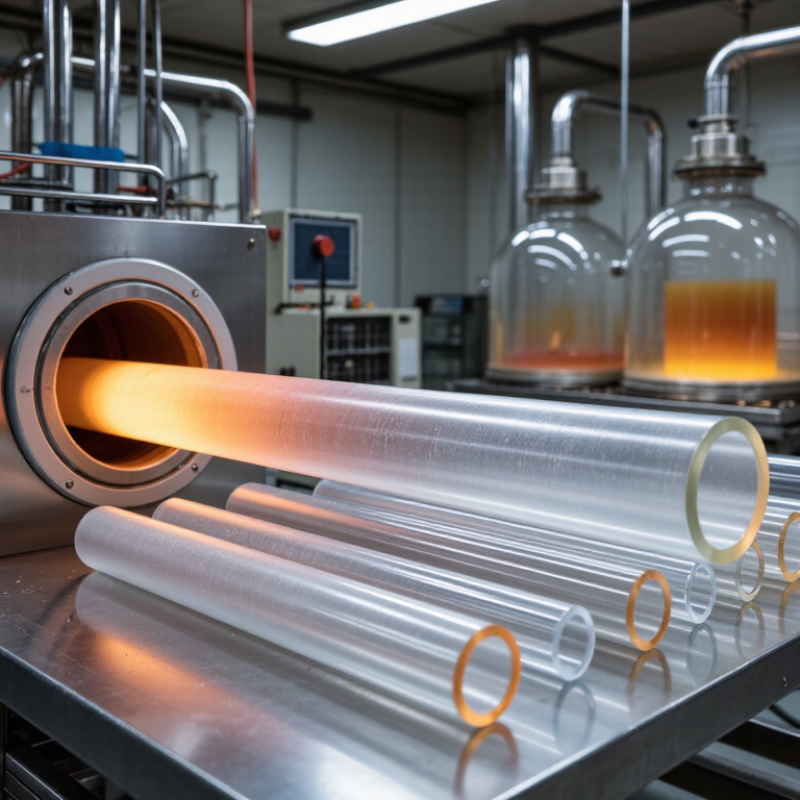
What Fused Quartz Is and How It Is Produced
Fused quartz is high-purity silica melted into glass. It is not ordinary window glass. During cooling, the atoms lose quartz’s ordered crystal structure and form an amorphous solid with low thermal expansion. That matters when components face rapid temperature changes. Manufacturers start with selected quartz or silica feed and remove contaminants that can affect optical, electrical, or thermal performance.
The feed is melted using electric or flame-based processes, then formed and cooled under controlled conditions. Producers machine tubes, plates, windows, or crucibles and inspect them for bubbles, inclusions, and dimensional errors. The USGS’s 2024 Mineral Commodity Summaries put U.S. industrial sand and gravel output near 120 million metric tons in 2023. That figure describes a broad commodity stream, not the amount of high-purity feed used for fused quartz.
Ordinary industrial sand is not automatically suitable. That distinction is easy to miss. Fused quartz’s low expansion helps parts withstand thermal cycling, but purity, surface finish, and component shape also matter. In a hot furnace, one trapped inclusion can become a weak point. Even carefully made parts may crack if thermal gradients are severe or mounting is poor.
Why Choose Fused Quartz for Industrial Applications? — What Fused Quartz Is and How It Is Produced
| Dimension | Typical information | Industrial significance |
|---|---|---|
| Material identity | Fused quartz is an amorphous form of silica (SiO₂), made by melting high-purity crystalline quartz and cooling it without allowing the material to crystallize. | Its non-crystalline structure gives it different thermal and optical behavior from ordinary crystalline quartz. |
| Common production route | In electric fusion, selected quartz is heated in an electric furnace to a high-temperature melt, then formed and cooled under controlled conditions. | Careful control of raw-material purity and processing helps limit bubbles, inclusions, and other defects. |
| Synthetic silica route | Synthetic fused silica can be produced from silicon-containing chemical feedstocks through vapor-phase oxidation or hydrolysis, followed by consolidation into glass. | This route can provide very high purity and allows properties such as hydroxyl content to be tailored for particular optical or process requirements. |
| Composition | Primarily silicon dioxide; trace impurities and hydroxyl (OH) content vary with the raw material and manufacturing process. | Composition affects optical transmission, contamination risk, and suitability for high-purity processes. |
| Coefficient of thermal expansion | Approximately 0.5 × 10⁻⁶ K−1 near room temperature, with the precise value depending on temperature and material grade. | Very low expansion helps components retain dimensional stability through temperature changes and resist thermal shock. |
| Density | Approximately 2.2 g/cm³ at room temperature. | Provides a useful combination of low mass and the mechanical characteristics needed for many glass components. |
| High-temperature behavior | Fused quartz has a high softening temperature; a commonly cited value is about 1,660°C. This is a viscosity-based softening point, not a sharp crystalline melting point. | It can be used in high-temperature equipment, although allowable operating temperature depends on load, exposure time, geometry, and thermal cycling. |
| Thermal conductivity | About 1.3–1.4 W/(m·K) near room temperature; the value varies with temperature and material condition. | Its relatively low thermal conductivity compared with many metals can help reduce heat transfer, while component design must account for temperature gradients. |
| Chemical behavior | Generally resistant to many acids and process chemicals, but it is attacked by hydrofluoric acid and can be affected by strong alkalis, particularly at elevated temperatures. | Useful in many demanding chemical environments, but compatibility should be checked against the actual chemical concentration, temperature, and exposure time. |
| Optical transmission | Can transmit ultraviolet, visible, and near-infrared radiation. The usable wavelength range depends on purity, hydroxyl content, thickness, and surface quality. | Supports use in optical windows, lamp envelopes, and semiconductor or analytical equipment where transmission requirements are specified by wavelength. |
| Electrical properties | Fused quartz is an electrical insulator; its dielectric behavior depends on temperature, frequency, purity, and the specific grade. | Can serve as an insulating material in high-temperature electrical and electronic assemblies when the design conditions are properly evaluated. |
| Typical industrial uses | Applications include furnace tubes, crucibles, process vessels, semiconductor equipment parts, laboratory ware, optical components, and UV-transmitting components. | These uses benefit from combinations of high-temperature capability, low thermal expansion, chemical resistance, and optical or electrical properties. |
| Key selection factors | Evaluate purity, bubble and inclusion limits, dimensions, surface finish, hydroxyl content, thermal history, and chemical exposure. | Matching the grade and fabrication quality to the operating environment is essential for performance and service life. |
Values shown are typical reference figures, not guaranteed specifications. Exact properties vary by grade, production method, temperature, and measurement conditions. “Fused quartz” and “fused silica” are sometimes used differently across industries; confirm the material definition and requirements with the applicable technical specification.
FAQS
It is high-purity silica melted into an amorphous glass. Its structure differs from ordinary window glass.
Selected silica feed is melted by electric or flame-based methods. The material is then formed, cooled, and inspected for bubbles or inclusions.
Its low thermal expansion helps reduce stress during heating and cooling. A furnace window may still crack if temperature gradients are severe.
It is used in furnace tubes, process vessels, sight windows, and laboratory equipment. Specific applications need suitable grades and component shapes.
Selected grades transmit ultraviolet light and provide electrical insulation. Thickness, surface finish, and fabrication quality can affect results.
It can resist some corrosive process materials. Check the specific chemical, temperature, and exposure time before use.
Scratches, poor mounting, and trapped inclusions can weaken it under thermal stress. Even a carefully made part has limits.
Yes. High temperatures may cause surface changes, and machining or replacement can be difficult. A small test part may expose issues, though it cannot predict everything.
Conclusion
Fused Quartz is a high-purity glass made by melting silica and cooling it into a solid material. Its production gives it a distinctive combination of properties, including excellent resistance to high temperatures and thermal shock, low thermal expansion, strong chemical stability, and good optical transmission. These qualities help equipment withstand demanding conditions while maintaining reliable performance and reducing the risk of damage from rapid temperature changes or exposure to many corrosive substances.
Across industries, Fused Quartz is used in components such as tubes, vessels, windows, and process tools for applications involving heat, chemicals, or precise light transmission. Choosing the right component depends on its operating temperature, chemical environment, dimensions, purity requirements, and mechanical demands. Considering these factors helps match the material to the process and supports durability, consistent results, and efficient operation.