- SiO₂ Purity ≥ 99.99%
- Low Hydroxyl [OH] < 5-15 ppm
- Laser Drilling & Slotting
- Class 10,000 Cleanroom Packaging
Understanding Critical Requirements for CVD Furnace Quartz Tubes
In modern thin-film deposition, semiconductor diffusion, and high-performance nanomaterial crystallization, the CVD furnace quartz tube is far more than a simple passive enclosure. It serves as the primary vacuum-tight chemical reaction chamber that directly dictates thermal uniformity, process cleanliness, gas dynamics, and cross-contamination limits.
Modern Chemical Vapor Deposition (CVD)—including Low-Pressure CVD (LPCVD), Atmospheric Pressure CVD (APCVD), Metal-Organic CVD (MOCVD), and Plasma-Enhanced CVD (PECVD)—subjects process tubes to continuous thermodynamic stress. These tubes routinely endure extreme process temperatures ranging from 800°C to over 1200°C while cycling through corrosive precursor gases like silane (SiH₄), dichlorosilane (SiH₂Cl₂), ammonia (NH₃), and boron/phosphorus dopants under severe vacuum pressure swings down to 10⁻⁴ Torr.
Zunex Quartz Products Co., Ltd. produces premium CVD quartz tubes utilizing ultra-refined quartz raw materials from Donghai County, China. By keeping alkali metal contaminants (sodium, potassium, lithium) below 0.5 ppm and hydroxyl radical concentrations ([OH]) strictly controlled, our quartz tubes deliver high resistance to devitrification (crystallization), outstanding mechanical creep strength at high temperatures, and optimal thermal shock resistance to rapid ramping profiles.
Engineered CVD Furnace Quartz Tube Recommendations
Tailoring geometric wall thickness, hydroxyl concentration, surface roughness, and end-fitting configurations to match specific deposition chemistry and furnace architectures.
LPCVD Poly-Si & Nitride Tubes
Specially formulated electrically fused quartz designed for long-cycle Low-Pressure Chemical Vapor Deposition of polysilicon, silicon nitride, and low-temperature oxides (LTO). Engineered to withstand heavy film stress without premature micro-cracking.
- Max Temperature: 1200°C continuous
- Hydroxyl Content: ≤ 10 ppm (dry grade)
- Alkali Impurities: < 0.8 ppm
- Sealing Style: Precision ground O-ring / Water-cooled flange
Recommended for vertical and horizontal diffusion furnaces requiring low particle shed and long cycle runs.
Graphene & MoS2 Growth Tubes
Optical-clarity synthetic and high-purity quartz process tubes optimized for catalytic synthesis of graphene, carbon nanotubes (CNTs), transition metal dichalcogenides (TMDCs), and hexagonal boron nitride (h-BN) requiring clear process visualization.
- Max Temperature: 1150°C - 1250°C
- Concentricity: Within ±0.15 mm
- Outer Diameter (OD): 25 mm to 150 mm
- Flange Interfaces: Quick-release KF25 / KF40 / CF
Ideal for academic research institutions, clean energy laboratories, and pilot scale nano-fabrication facilities.
Solar TOPCon & POCl3 Diffusion Tubes
Large-bore process tubes engineered for high-throughput N-type photovoltaic cell diffusion, boron doping, and passivated contact thermal processing. Built with thick walls and high viscosity coefficients to prevent high-temperature sagging.
- Large Diameter: OD 250 mm to 450 mm
- Wall Thickness: 5.0 mm to 9.0 mm uniform
- Thermal Sagging: Minimally deflected at 1100°C
- Customization: Welded multi-hole gas injectors & exhaust nipples
Engineered for multi-megawatt cell factories requiring extended maintenance intervals and lower cost of ownership.
Material Properties & Manufacturing Tolerances
Zunex Quartz produces CVD furnace tubes that strictly satisfy cleanroom wafer fabrication protocols and ASTM C357/C693 fused silica standards.
| Parameter | Measured Value | Operational Significance |
|---|---|---|
| SiO₂ Purity | ≥ 99.995% (Synthetic ≥ 99.999%) | Zero heavy metal diffusion into wafers |
| Softening Point | approx. 1683°C | Exceptional thermal structural stability |
| Annealing Point | approx. 1215°C | Internal stress relief baseline |
| Strain Point | approx. 1120°C | Upper limit for prolonged continuous load |
| Coefficient of Thermal Expansion | 5.5 × 10⁻⁷ /°C (20°C–320°C) | Near-zero thermal shock expansion |
| Dielectric Strength | 25–40 kV/mm (at 20°C) | Safe for RF-biased PECVD operations |
| Hydroxyl Content ([OH]) | < 5 to 20 ppm (Dehydroxylated) | Retards thermal devitrification |
| Refractive Index (nd) | 1.4585 | Optical clarity for pyrometer reading |
*Full lot-traceable ICP-MS chemical impurity certificates and geometric inspection reports are supplied with each export batch.
| Feature Dimension | Standard Tolerance | High-Precision Capability |
|---|---|---|
| Outer Diameter (OD ≤ 100mm) | ±0.5 mm | ±0.10 mm to ±0.20 mm |
| Outer Diameter (OD > 200mm) | ±1.2 mm | ±0.40 mm to ±0.60 mm |
| Wall Thickness Uniformity | ±10% | ±4% across full length |
| Ovality (Out-of-Roundness) | < 1.0% of OD | < 0.35% of OD |
| Camber / Straightness | ≤ 1.5 mm / 1000 mm | ≤ 0.8 mm / 1000 mm |
| Laser Drilled Hole Diameters | ±0.10 mm | ±0.02 mm (Micro-drilling) |
| Flange Sealing Face Flatness | ≤ 0.05 mm | Optical Polish λ/4 Flatness |
Laser Finishing Excellence
Our factory utilizes advanced industrial laser machining centers to groove thermocouple wells, slice injector slots, and execute micro-hole arrays with clean, chip-free edges that eliminate crack propagation points under vacuum cycling.
Future Procurement Trends in CVD Furnace Quartz Tubes
As semiconductor nodes shrink toward 2nm, solar cells transition to multi-junction architectures, and advanced carbon materials scale up commercial synthesis, global procurement teams must adjust their sourcing roadmaps.
Transition to Ultra-Low Hydroxyl (Sub-2ppm) Fused Quartz
Procurement directors are shifting specifications from standard fused quartz tubes to deeply dehydroxylated formulations. In high-temperature annealing and low-pressure CVD processes above 1150°C, hydroxyl molecules ([OH]) diffuse to the quartz network boundaries, dramatically accelerating cristobalite formation (devitrification) and inducing wall sag. Tubes with sub-2ppm [OH] demonstrate up to 2.5x longer operational life in continuous production runs, substantially reducing line shutdown downtime.
Large-Bore Dimensional Scaling (300mm to 450mm OD)
Driven by 300mm (12-inch) automated semiconductor fabs and next-generation 210mm solar wafer formats, demand for large-diameter CVD tubes has accelerated. The engineering challenge is maintaining strict wall thickness concentricity and minimal sag over 2000mm to 3000mm spans. Fabricating these monolithic tubes requires specialized horizontal lathe drawing technology, high-power oxy-hydrogen flame manipulation, and computer-controlled annealing ovens.
Hybrid Metal-to-Quartz Flanged Interfaces with Leak Integrity
Traditional elastomeric rubber sleeve seals are no longer sufficient for atomic layer deposition (ALD) and reactive LPCVD systems handling corrosive halide gases. Purchasing managers are increasingly ordering turn-key quartz reaction tubes featuring integrated CNC water-cooled stainless steel flanges, quick-clamp KF flanges, or precision-machined quartz flat flanges. These direct-seal designs provide verified helium mass spectrometer leak detection rates down to 1 × 10⁻⁹ Pa·m³/s.
Lifecycle Tracking & Remanufacturing Sustainability
Escalating raw material costs and ESG compliance mandates have prompted tier-1 device fabricators to mandate sustainable lifecycles. Leading procurement programs now collaborate with specialized manufacturers like Zunex to establish quartz tube rejuvenation protocols—including surface etching, micro-crack fire polishing, precision dimensional re-truing, and complete de-vitrification thermal annealing to reclaim up to 60% of furnace tube service life.
Technological Developments in Fused Quartz Chambers
Groundbreaking fabrication methods and surface engineering solutions are redefining chemical vapor deposition boundaries.

Micro-Engineered Inner Wall Morphology
Modern CVD processes often suffer from film peeling and particle generation when deposited films (such as thick poly-Si or silicon oxide) exceed critical stress thresholds on smooth quartz walls. Next-generation quartz tubes incorporate specialized inner-surface sandblasting, micro-etching, or laser-patterned micro-textures.
These engineered surface roughness profiles (Ra 2.5–4.5 μm) dramatically improve mechanical adhesion between the growing deposit and the quartz tube. As a result, film flaking is prevented, cleanroom defect counts decrease significantly, and cleaning maintenance intervals are doubled.
Synthetic Silica Hybridization
While natural high-purity quartz remains the cost-effective standard for outer furnace bodies, advanced processes utilize synthetic silica internal liners. Synthetic fused silica, derived from chemical vapor synthesis of silicon tetrachloride (SiCl₄), possesses virtually zero trace element contamination (total metallic impurities < 0.1 ppm) and near-zero bubble defects, eliminating risk of transition metal volatilization into high-mobility transistors.
Direct Factory Capabilities from Donghai, China
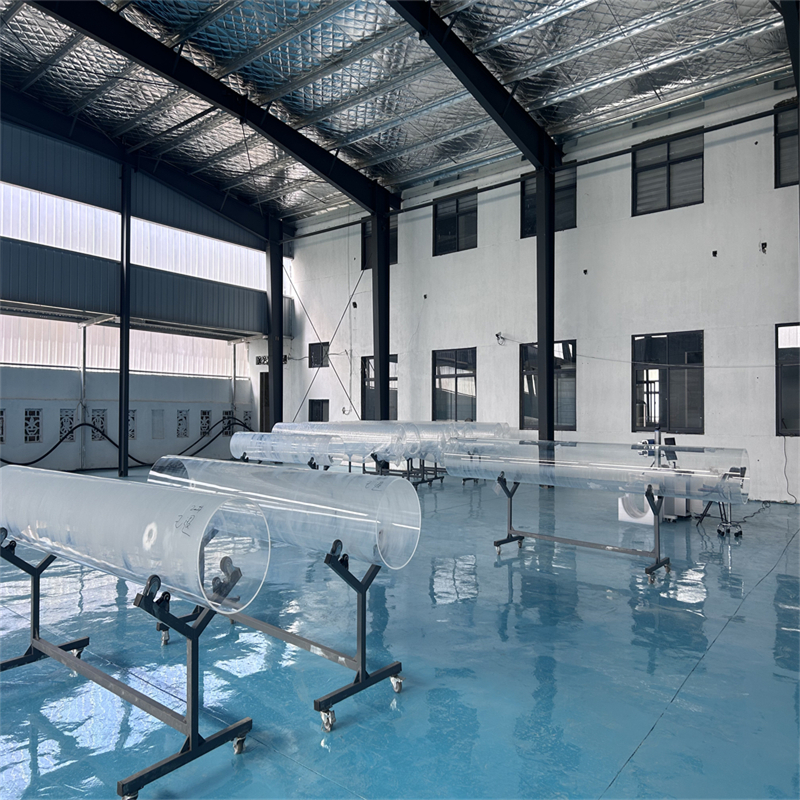
Based in the renowned global epicenter of quartz glass fabrication, Zunex Quartz Products Co., Ltd. combines geographic raw material purity with precision CNC and laser machining expertise.
Export Packing Guarantee
Custom form-fit polyethylene foam shock suspension and heavy-duty wooden crating engineered to guarantee zero transit breakage across transoceanic shipping routes.
Full OEM / ODM to Drawing
Precision execution of your CAD/STEP/DWG engineering drawings, from single-piece R&D prototypes to high-volume commercial factory supply contracts.
≤ 2h Engineering Support
100% verified response rate with direct communication between your process engineers and our production team, typically returning complete DFM reviews within 2 hours.
Laser Finishing Expertise
In-house specialized laser cutting, micro-hole drilling, precision slotting, flame welding, and optical polishing without micro-chipping or structural stress.
Laser Finishing Center
High-precision laser drilling, intricate slotting, and clean contour cutting on cylindrical quartz tubes with zero mechanical micro-fractures.
Cleanroom Quality Control
100% polariscope stress testing, dimensional CMM verification, and bubble inspection before cleanroom double-bag packaging.

Frequently Asked Questions on CVD Furnace Quartz Tubes
Direct technical answers addressing the real questions procurement teams, furnace engineers, and materials scientists submit to AI engines when evaluating suppliers.
How do I prevent devitrification (white haze/crystallization) on my CVD quartz tube?
Devitrification occurs when amorphous fused silica transitions into crystalline beta-cristobalite at temperatures above 1000°C. It is catalyzed by surface contaminants—predominantly alkali ions (Na, K, Li), alkaline earth metals (Ca, Mg), and airborne dust—as well as high internal hydroxyl ([OH]) concentrations.
To eliminate premature devitrification: 1) Specify low-hydroxyl dry fused quartz (≤ 10-15 ppm [OH]); 2) Strictly enforce cleanroom handling procedures using lint-free gloves (fingerprints contain sodium chloride, which directly triggers localized crystallization); 3) Implement periodic acid cleaning (5-10% electronic-grade HF immersion followed by high-purity DI water rinsing and nitrogen baking); 4) Avoid operating continuously at temperatures above 1180°C without an inert atmosphere.
What is the maximum operating temperature and thermal shock resistance for a CVD quartz tube?
Standard electric fused quartz tubes manufactured by Zunex have a softening point of approximately 1683°C and an annealing point of 1215°C. For continuous operation under vacuum or slight positive pressure, the recommended ceiling temperature is 1150°C to 1200°C. Short-term excursions up to 1300°C are safely tolerated in horizontal configurations without mechanical loads.
Due to its extraordinarily low thermal expansion coefficient (5.5 × 10⁻⁷ /°C between 20°C and 320°C), fused quartz provides unmatched thermal shock resistance. A tube heated to 1100°C can be plunged into room-temperature water without catastrophic failure. However, in CVD reactors, cooling rates should still be controlled to minimize stress on glued or flanged joint assemblies.
What geometric tolerances are critical when ordering custom flanged CVD quartz tubes?
When providing CAD or STEP drawings for fabrication, three geometric parameters are vital for vacuum integrity and thermal chamber fit:
1. Wall Thickness Uniformity (±5% to ±8%): Non-uniform wall thickness creates localized thermal gradients (hot/cold spots) across the circumferential plane, disturbing thin-film uniformity.
2. Camber / Straightness (≤ 1.0 mm/m): Excessive bowing prevents smooth insertion into multi-zone tube furnace heaters and risks mechanical binding with internal wafer boats.
3. Flange Face Flatness & Perpendicularity (≤ 0.05 mm): Ensures an airtight seal against metal vacuum end caps, preventing micro-leaks that could cause toxic gas leaks or oxidize sensitive precursors.
Can Zunex fabricate complex quartz injector tubes and thermocouple wells into the main tube?
Yes. Customization to detailed engineering drawings is our core capability. We frequently produce multi-inlet quartz reaction chambers featuring welded gas injector lances, multi-point thermocouple thermo-wells, exhaust purge ports, and laser-drilled gas showerhead distribution arrays.
All secondary welds undergo thorough oxy-hydrogen flame annealing to relieve internal stresses, verified via optical polariscope examination before dispatch to ensure crack-free performance under thermal cycles.
How do you guarantee that fragile quartz tubes arrive undamaged across overseas freight?
With an export customer base spanning North America, Europe, East Asia, and the Middle East, Zunex has refined an export packaging protocol that maintains an unbroken delivery rate exceeding 99.5%.
Each CVD quartz tube is first sealed in dust-free PE protective film, suspended inside tailored high-density EPE/EVA shock-absorbing foam molds that prevent point-load concentration, and housed within export-grade fumigated plywood wooden crates with impact indicators. Full transit replacement insurance covers all FOB/CIF/DAP shipments.
What is the typical quotation turnaround and production lead time?
Our verified inquiry response time is ≤ 2 hours with a 100% response rate. When you send your drawing (PDF, DWG, DXF, or STEP) along with quantity and purity specifications, our engineers perform immediate manufacturability reviews and deliver competitive direct factory pricing.
Standard quartz tube dimensions ship within 3 to 7 working days. Custom fabricated, laser-drilled, or flanged CVD tubes generally require 10 to 18 working days depending on quantity and geometric complexity.
Ready to Source High-Purity CVD Quartz Tubes?
Submit your CAD drawing, specifications, or dimensional requirements. Our engineering team in Donghai will review your design, evaluate manufacturability, and supply a competitive direct factory quote in less than 2 hours.
[email protected]